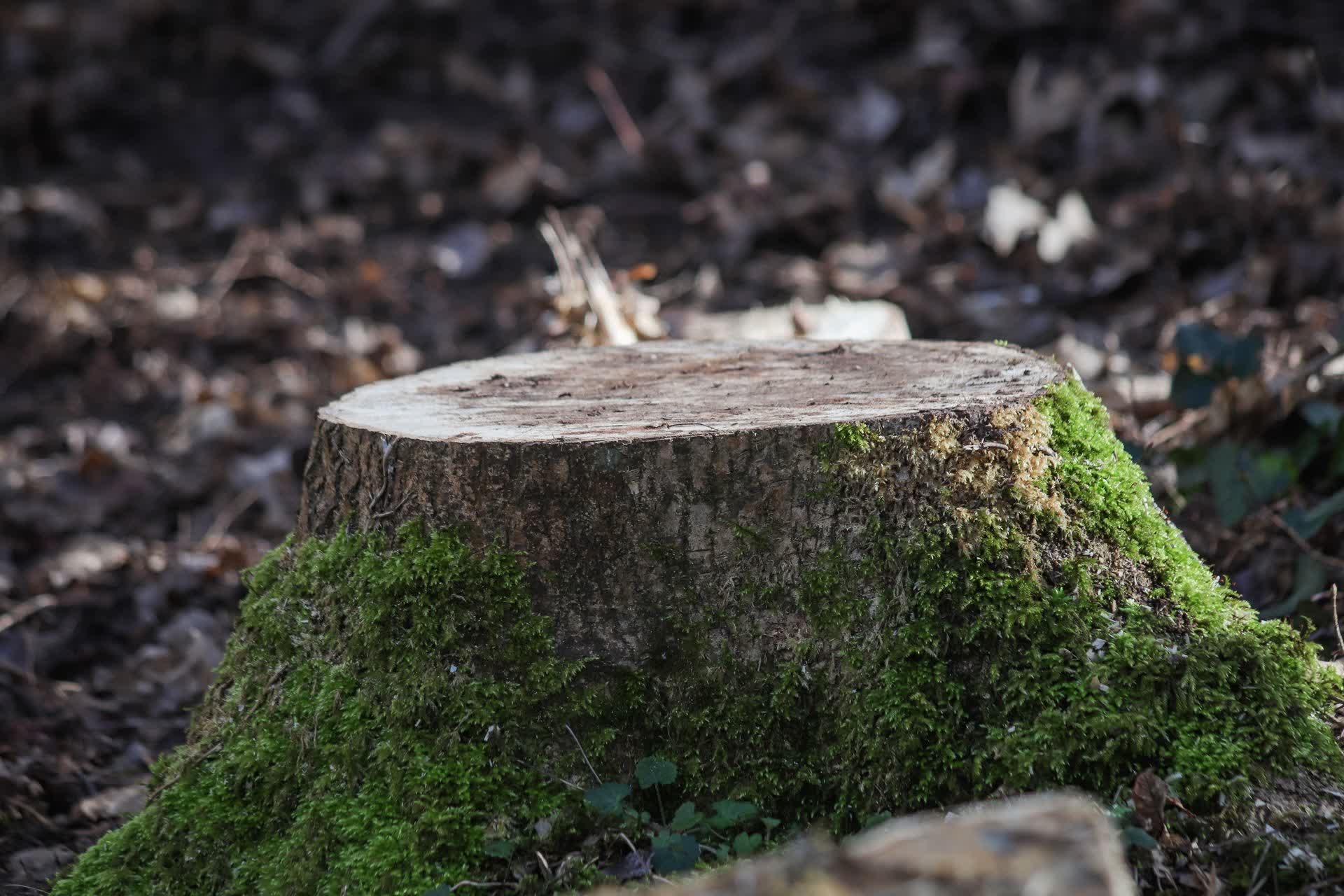
Once a tree is cut and its stump is ground, homeowners often ask what happens to the roots still buried in the yard. The honest answer is more nuanced than the internet usually presents. In most cases, roots gradually die back and decompose. In some cases, certain species can send up sprouts for a season or two before they finally exhaust themselves. Here is what to expect and how to plan around it.
Direct answer
Whether roots continue any kind of growth after grinding depends on the species, the condition of the tree, and whether living sprouts or connected growth remain. For the majority of Hill Country hardwoods, the root system slowly declines and disappears into the soil over years. For a small number of species, sprouts can appear during the first growing season and need to be managed until they stop.
How roots receive energy
Roots do not make their own food. They rely on sugars produced by the leaves, sent down through the trunk. When the canopy is gone and the stump is ground below grade, that supply is cut off. Without energy coming down, the underground system has nothing to sustain growth.
What usually happens after the canopy and trunk are removed
In most cases, root activity winds down quickly. The roots hold on for a while because they still contain stored sugars, but that reserve is finite. Once it is used up, the roots die back and are broken down by soil microbes and fungi.
Why roots do not disappear immediately
Underground wood decomposes slowly, especially in dry Hill Country soil. That is why the ground above old stumps does not collapse suddenly. The roots shrink in place, and the surrounding soil settles gradually over time.
How long underground roots may remain
A general expectation is several years for full decomposition, though the timeline depends heavily on species, soil moisture, and how deep the roots were. Irrigated lawns speed it up. Rocky, dry pastures slow it down.
Root decomposition
Decomposition is quiet. You will not see anything happening on the surface beyond occasional mushrooms and gradual settling. The wood becomes softer, then punky, then soil-like. At the end of the process, the space is just soil.
Species that may send up sprouts or suckers
A handful of trees are known for stubborn regrowth from lateral roots. Hackberry, chinaberry, mulberry, and certain ornamentals like crepe myrtle are on that list. In these cases, small shoots can appear away from the stump location during the first growing season after grinding.
The presence of sprouts does not mean the grind failed. It means the species behaves that way. Repeated cutting or careful spot treatment usually exhausts the root system within a season or two.
If you have a known sprouter, plan on watching the area for shoots during the first spring and summer after the grind. Cutting them back promptly is often enough to end the cycle.
What homeowners should do if shoots appear
For most people the practical approach is to cut new shoots back to the ground whenever they appear. Each cutting drains the root system a little more. If shoots persist stubbornly, a licensed applicator can help identify a targeted treatment that respects the label and local requirements.
Root flare versus lateral roots
The root flare is where the trunk widens at the base and ties into the ground. Grinding removes it. Lateral roots are the horizontal roots that fan out from the flare into the yard. Grinding does not chase them across the property. On species prone to sprouting, sprouts sometimes appear from these lateral roots, not from the ground stump itself.
Surface-root grinding
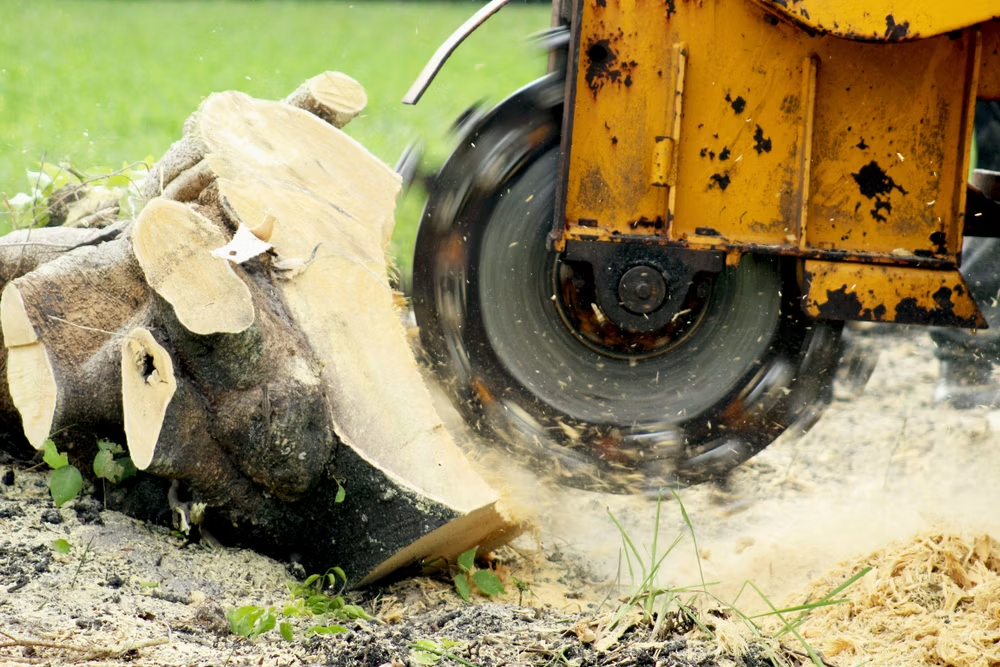
If large surface roots are running across a lawn or flowerbed, they can often be ground down as part of the job. That work removes tripping and mowing hazards without excavating the entire lateral root system.
Roots near foundations, pipes, and pavement
This is a topic that deserves careful language. In some cases, roots that were pressing against structures continue to shrink after the tree is gone, which can slightly relieve pressure. In other cases, damage that already happened does not undo itself. Whether existing damage was caused by tree roots or by other factors is a professional judgment for an arborist, plumber, or engineer.
When an arborist, plumber, engineer, or other specialist may be needed
For active plumbing intrusion, foundation movement, or structural questions, professionals with the right training and licensing should be involved. Stump grinding removes the stump and root flare. It is not a substitute for a plumbing camera, a foundation inspection, or an arborist's report.
Hill Country tree considerations
Local species behave differently. Live oak and post oak are generally low-drama after grinding. Cedar elm and pecan follow suit in most cases. Hackberry and mulberry are more likely to sprout. Ashe juniper, commonly called cedar, generally does not sprout meaningfully once the stump is properly ground.
Tell us on the estimate. We will spec depth and flag the follow-up plan for you.
Quick FAQs
Do I need to poison the roots after every grind?
Not for standard hardwoods. It is more of a case-by-case conversation for known sprouters, and any treatment should follow the product label and applicable rules.
How long until all activity stops?
Sprouting, if it happens at all, usually stops within a season or two. Full underground decomposition takes longer and depends on species and soil conditions.
Will old roots damage my foundation later?
Dead roots do not grow. In many cases they simply shrink and decompose. Structural questions belong with an engineer or arborist.
Should I be worried if I see mushrooms?
Mushrooms are common as buried wood decays and are usually harmless. If children or pets are around, they can be knocked over as they appear.
Can neighboring trees be affected by grinding?
In most cases no. Grinding is highly localized and does not disturb the wider soil like full excavation would.