This question comes up almost every week. The short answer is that grinding effectively ends most of what the root system can do, but it does not physically excavate every root out of the ground. The way the wood dies back and the timeline for it depend partly on what species you were dealing with. Here is the honest version.
Direct answer
Grinding kills the tree's ability to continue growing in most cases, and for the majority of Hill Country hardwoods that includes the underground root system. The roots decline gradually, break down in the soil, and disappear over the course of years. On a small number of species, grinding may not stop every sprout on the first pass, and follow-up care may be needed for a season or two.
What the grinder physically removes
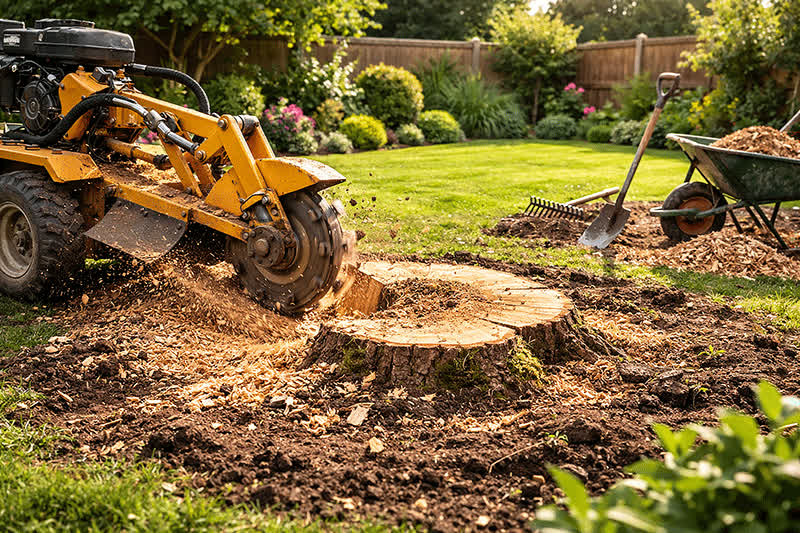
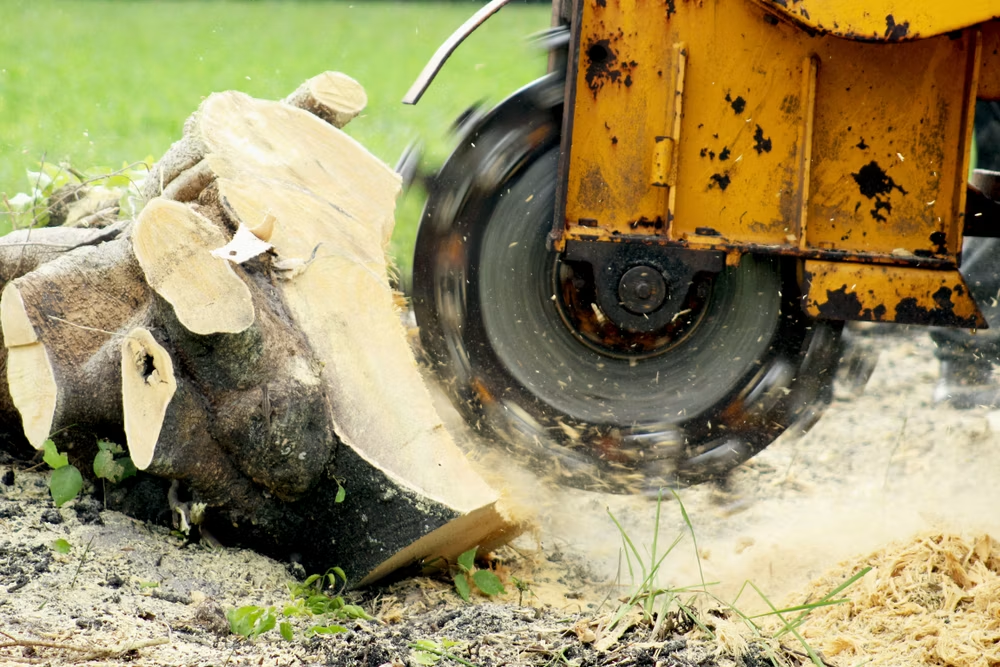
The wheel takes down the visible stump and the root flare where the trunk ties into the ground. Large surface roots can also be addressed as part of the job. That is the physical scope of grinding.
What remains underground
Everything below the depth of the grind stays where it is. Lateral roots and deeper structural roots remain in the soil. They are no longer connected to a canopy that can feed them, but they still exist as buried wood.
Difference between cutting off the tree's energy source and grinding every root
Killing a tree and digging up every root are not the same thing. Grinding cuts off the energy supply that keeps roots alive. Excavation is a separate, much larger operation that physically removes roots from the ground. Most homeowners want the first, not the second.
Why many roots gradually decline
Without leaves producing sugars, the underground system runs out of fuel. Existing stored energy is finite. Once it is consumed, growth stops, and decomposition begins.
Why some trees may continue sprouting
A few species can push new shoots from lateral roots even after the stump is ground. Hackberry, mulberry, chinaberry, and certain ornamentals are typical examples. If sprouts appear, cutting them back promptly each time exhausts the roots faster.
Root flare
The flare is the widened base where the trunk meets the ground. That zone is where dormant buds most commonly try to activate on sprout-prone species. Grinding the flare below grade is a key part of why sprouting is uncommon on most Hill Country hardwoods after a proper grind.
Surface roots
If surface roots are a tripping hazard or interfere with mowing, they can be leveled as part of the job. Their removal is cosmetic and functional, it does not change the biology of what the tree can or cannot do.
Grinding versus complete excavation
Complete excavation is a specialty scope. It uses an excavator or similar machine to pull the whole root ball out of the ground. It leaves a crater that must be backfilled, and it disturbs a large area around the former stump. Grinding is a targeted operation that leaves the surrounding soil largely undisturbed.
Situations where full root removal may be required
Some construction projects require clean fill without any wood in the ground. Certain utility trenches, foundation pads, or engineered structures spec that. In those cases, a builder may call for excavation rather than grinding.
Herbicide discussion
There is a place for chemical treatment on stubborn sprouters, but detailed application guidance belongs on product labels and with licensed professionals. Any treatment must follow the product label and applicable Texas rules. If you are not confident in the process, a licensed applicator can help.
Tell us the type of tree on the estimate and we will explain what to expect afterward.
Quick FAQs
Will neighboring trees be hurt by the grinding?
In most cases no. Grinding is localized and does not disturb the wider root systems of adjacent plants.
How soon are the roots really dead?
Growth from the roots effectively stops when the stump and flare are gone. Full decomposition takes years.
Do I have to treat the stump with anything?
For most Hill Country hardwoods, no. For known sprouters, targeted follow-up may be worth it.
Is deeper grinding better for stopping regrowth?
The standard residential depth is generally enough. Extra depth is more about what you are building on top than about regrowth.